COUNCIL OF THE CITIZENS OF THE VAL D'ULTIMO - DIALOGUE WITH THE POPULATION
With this project, Alperia aims to contribute to the energy transition and ensure the stability of energy supply in South Tyrol. In this way, the company is fulfilling its commitments to the owners, the Autonomous Province of South Tyrol and the South Tyrolean municipalities, contributing to the region's climate neutrality by 2040.
The implementation of projects of this kind has a significant impact on the regions concerned and their communities, particularly during the construction phase. On the one hand, there may be temporary inconvenience associated with construction activities; on the other hand, positive effects can be generated through appropriate compensation measures, the creation of new jobs and the development of local value chains.
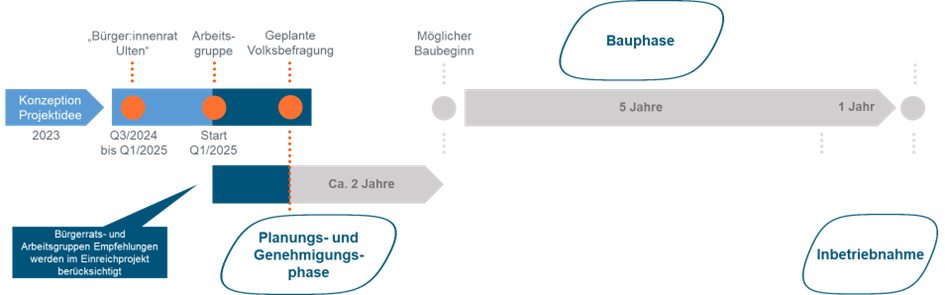
In order to enable the population to obtain information, exchange views, express their interests and evaluate new perspectives, the Ulten Citizens' Council, open to all, was launched in autumn 2024. This concluded in February 2025 with the presentation of the final report. Immediately afterwards, the municipality of Ulten set up the “für-ulten” working group as an additional forum for dialogue.
The Citizens' Council, decided by the municipality of Ulten and financed by Alperia, aimed to enable participants and interested members of the public to learn more about the pumped storage power plant project and to answer any questions they might have. The context of the project, the course of the work, the advantages and disadvantages for the Ulten Valley, the environmental effects, the impacts during the construction phase and possible compensation measures were presented and discussed.
The results of the Ulten public consultation and the “für-ulten” working group provide a solid basis for decision-making by the population and contain concrete recommendations for municipal representatives, the Provincial Council and the project promoter, Alperia.
This open and transparent dialogue is also a sign of respect for Val d'Ultimo, which has already made an important contribution to South Tyrol's energy development in the past. The discussions held so far in Val d'Ultimo clearly show how important this dialogue is for all citizens concerned, the administration, politicians and the project promoter.
QUESTIONS AND ANSWERS ABOUT THE PROJECT IDEA FOR A PUMPING STATION
The schedule calls for the planning and approval process to begin following dialogue with the population. Once the authorisation procedure is complete, the construction phase will follow, estimated to take approximately 5 years. After commissioning, the pumped storage power plant will begin commercial operation.
Pumped storage power plants are particularly suitable for South Tyrol, thanks to the prevailing topography and the presence of existing reservoirs. This is a well-established technology for large-scale energy storage. Thanks to the size of the two reservoirs, the new plant could store large amounts of energy, for example to temporarily absorb excess energy produced by photovoltaic and wind power plants.
Unlike pumped storage power stations, large batteries offer much more limited storage capacity, have a significantly shorter lifespan, take up valuable surface space and require raw materials that are not available locally in South Tyrol.
However, battery storage systems remain indispensable for the energy transition thanks to their high flexibility, modular structure and relatively short construction times.
The annual cycle of the Zoccolo reservoir is mainly influenced by its tributaries: the lake is emptied in winter and filled during the spring snowmelt. No significant changes to this natural cycle are expected.
Seasonal fluctuations in the water level will therefore remain largely unchanged even after the pumping station is built.
However, due to the operation of the pumps in winter, the minimum operating water level would increase compared to today, while the maximum level in summer would remain unchanged.

During the summer, the water level in the Zoccolo reservoir may vary by approximately 10 centimetres per hour due to the operation of the pumped storage plant.
A key request from the Citizens' Council (Final Report of 14 February 2025) is to investigate the hydrogeological situation in more detail and provide more precise information on the springs concerned, in view of the planned referendum. For this reason, hydrogeological monitoring of the springs will be carried out, which will allow geologists to assess whether the tunnel construction work could affect a spring during the construction phase. The results will be published before the referendum.
In summary, monitoring offers the following advantages:
- Creation of the information base required for the referendum;
- Documentation of the current state of the springs before the start of construction (e.g. flow rate, temperature, quality) as a reference for any future effects;
- Definition of contingency plans in case of restrictions on the use of the springs;
- Continuous measurements during construction to identify any changes in a timely manner, allowing for rapid intervention (e.g. activation of contingency plans or changes to the construction method such as waterproofing).
Based on the investigations carried out so far and the available data, an initial geological model has been developed. At present, it can be stated that the chosen route is located outside of relevant disturbance systems, tectonic lines and geologically unstable areas.
The work will mainly be carried out underground, with access at three points: at the top (Quaira), at the bottom (Zoccolo artificial lake) and in the middle (plant room).
Approximately 500,000 m³ of excavated material is expected to be produced (about one-fifth of that moved in the Resia artificial basin in 2023/2024). According to initial assessments, the material is suitable for recycling and can be reused both on the construction site itself and in other building projects in the valley (e.g. for infrastructure improvements).
The excavated material will be transported from the access portals to the storage area on the western shore of Lake Zoccolo mainly by cableway, which will be dismantled at the end of the works.
Building materials such as concrete, steel and turbines, which are not available locally, will be transported downhill via the provincial road.
No changes will be made to the dams in the event of the construction of the pumped storage power plant. The stability of the dams and banks is constantly monitored by operational staff, external experts and consultants, as well as by the national dam supervisory authority, which is part of the Department of Infrastructure.
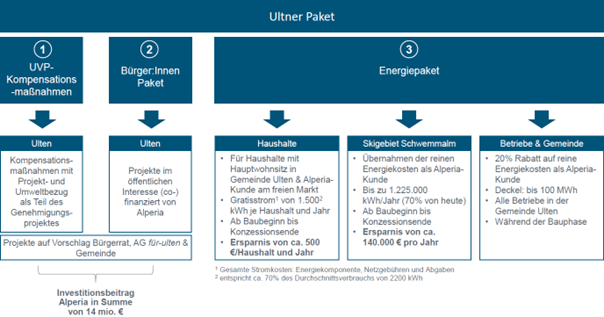
The ‘Ultimo Package’ is Alperia's offer in the event that the project idea is implemented, subject to a positive outcome of the referendum. It is the result of discussions and negotiations by the Citizens' Council and is part of the final report. It is based on three main pillars:
- The first two concern projects of environmental importance and public interest, co-financed by Alperia with £14 million;
- The third pillar, the energy package, provides free electricity for all households in the municipality of Ultimo for the first 1,500 kWh/year for the entire duration of the concession. In addition, Alperia will cover up to 70% of the pure energy costs of the Schwemmalm ski area and guarantee a 20% discount on pure energy costs for the municipality and businesses during the construction phase.